
The Catholic Association of Teachers, Schools, and Colleges
Standing Orders for the administration of the Association
These Standing Orders refer to the Constitution and should be read alongside it.
1. Name
The Catholic Association of Teachers Schools and Colleges shall be referred to as the Association, or CATSC.
2. Aims
2.1 Aims
The aims of the Association shall be to;
1. promote Catholic education by building upon existing strengths within our schools and colleges.
2. safeguard the interests of Catholic education for the benefit of pupils, students, teachers and governors.
3. act in the best interests of all who work in Catholic Schools and Colleges in England and Wales.
4. encourage all who work in Catholic schools and colleges to be members, either as individuals or as staff within the institution.
2.2. Objectives
Aware of the needs and demands required in the service of Catholic education, the Association will:
seek to proclaim the Good News of Christ through the life and activities of schools and colleges, and in the sharing of beliefs and faith with others
recognise and develop its distinctive role in the life of the Church
by participating in the mission of schools and colleges
by developing the vision of Catholic education act as a Catholic voice for teachers, schools and colleges in education,
by establishing a means of expressing and representing views at local, diocesan, national and international level.
create a network of support for colleagues in Catholic education by offering guidance and advice on personal, professional and spiritual matters, and
by developing action on issues of concern to teachers, schools, and colleges and all other catholic teachers.
3. Membership
3.1. Subscriptions;
a. Institutional members
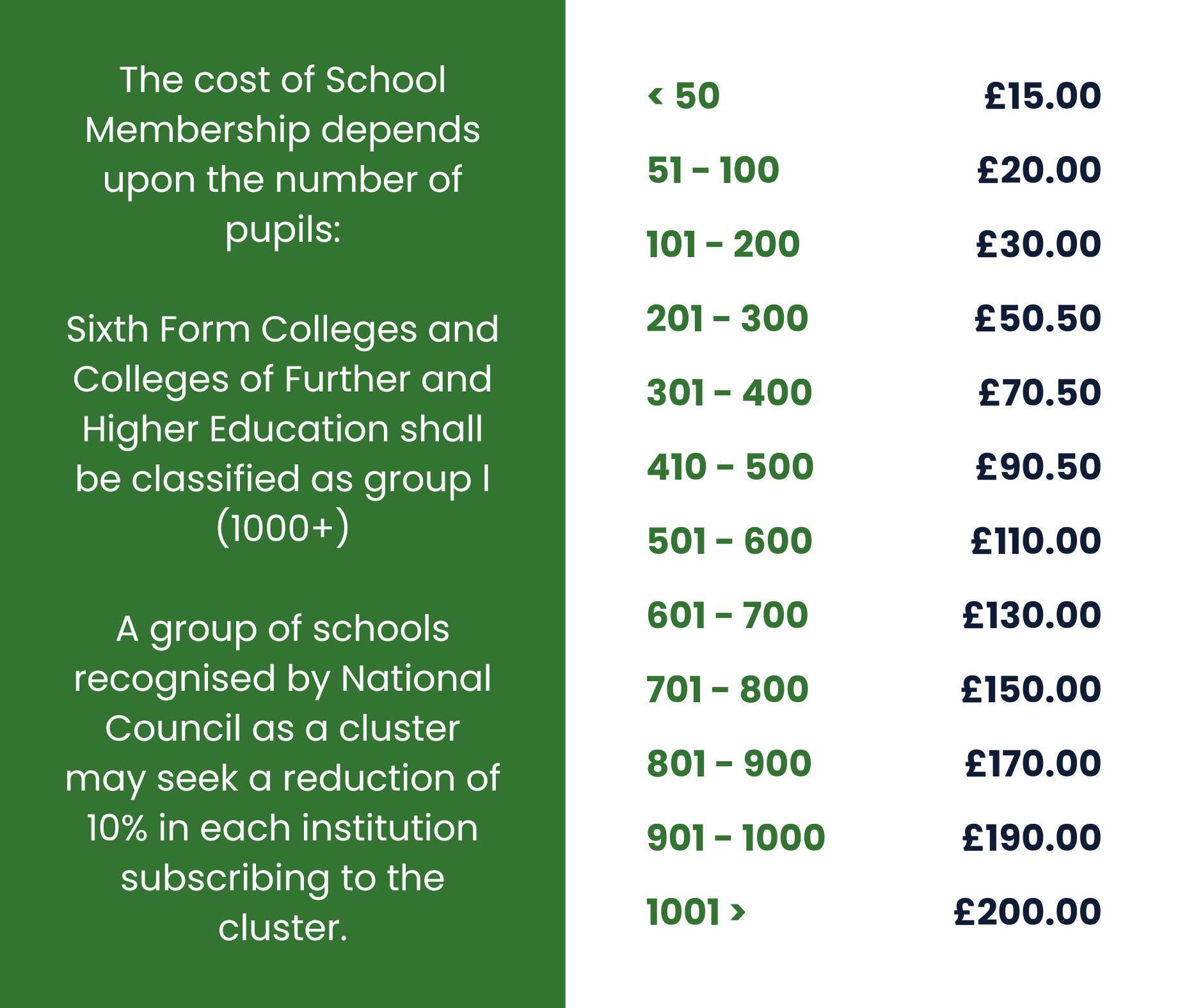
The subscription, due on September 1st shall be based on the number of pupils in the school, as enumerated on the CES Census form (PLASC or equivalent) in January of that year.
b. Individual membership
Individual Membership £15 per annum
d. Honorary Life Membership Awarded by National Council ex gratia
In recognition of past service to the Association or its forerunners, the National Council may approve a nomination for Life Membership.
An Honorary Life Member shall have the benefits of membership but shall not be eligible to stand for Office. The annual subscription is waived.
4. Rights and Benefits of Membership
Membership by subscription
Membership confers the rights as detailed in the Constitution, and in addition:
the right to receive professional advice without prejudice.
to be represented where the Association enjoys official recognition
to receive all mailings of the Association
to contribute to the aims of the Association
to express views to National Council on matters affecting Catholic education
to stand for office, and/or to nominate others for office.
a. Institutional Membership
All who work in a member Institution shall be eligible to benefit from the services of the Association.
Institutional Membership shall include a subscription to Networking. (This includes the provision of two copies of the magazine Networking).
b. Individual Membership
An Individual Member shall be eligible to the services of the Association which shall include a personal copy of all mailings (but does not include a subscription to Networking)
c. Honorary Life Membership
An Honorary Life Member shall benefit from all the rights of membership, as an individual member but shall not be eligible to stand for office.
Voting rights of members
a. Individual members shall have one personal vote.
b. Institutional members
Each institution shall be eligible to cast one vote for every unit of 50 pupils on roll.
Members attending meetings and eligible to vote on behalf of the institution may cast one vote only per person, up to the total of votes available for the institution. In the event of a postal ballot being arranged, evidence shall be sought for the number of persons representing an institution to confirm their participation and in accordance with the principles of voting by secret ballot.
No member may cast two votes, i.e. as an individual member AND as the representative of an Institution.
5. Local Associations and groups
a. A local Association may exist in each Diocese.
Where local groups are formed these may apply to the national Council for recognition. Such groups shall be considered a 'local association'. Otherwise, the term Local and Diocesan may be interchangeable. Where a local association exists, the National Council shall be empowered to determine whether it is of sufficient size and activity to warrant its own delegated Council member.
In the event of uncertainty, National Council shall decide the local group to which a member or institution shall belong
b. Proportion of funds
The National Treasurer shall refund to the Local/Diocesan Association 20% of the subscriptions collected from within the Local/ Diocesan Association, for local activities and development.
Such funds shall be maintained in a banking system, and the national Treasurer shall arrange access for the Local/Diocesan Treasurer to the funds of the local Association.
Any funds held on behalf of a local association, and not used for a period of 24 months shall accrue to the National account.
On the establishment or re-establishment of a local association, application may be made to the National Treasurer for a start-up fund. Following such formal constitutional establishment or re-establishment the Treasurer shall commence reimbursement of the appropriate subscription proportion, which action shall be ratified by the next National Council.
6. National Executive Council Membership
The Council shall not normally exceed 40 members.
a. Officers 4: (President, Past President or Vice President in alternate years, General Secretary, Treasurer)
b. Members: Maximum 36
Roles;
National Council shall appoint such members as it deems necessary to carry out duties as it shall approve. Currently these include:
General Secretary | Business Development
Minutes Secretary | Editor
IT and Website | 14-19
Handbook | Conference
Primary Conference | Secondary Conference
One day issues | Recruitment
Publicity | Primary Convenor
Secondary Convenor | Retired & Life Members
Research & Development | International Links
WUCT
c. The Chaplain to Council and the Bishop appointed for Episcopal Liaison shall be deemed Ex Officio Members of Council and Executive.
d. The Council shall seek to ensure that the following 'interest' groups are represented;
Primary class teacher | Primary Head/Deputy
Secondary class teacher | Secondary Head/Deputy
Grant maintained schools | Special schools
FE or HE | Individual and retired members
Independent schools
The Council shall have power to co-opt a member from any of these groups which are not represented by a member on the council.
Representative members
National council shall appoint such members to represent the Association on other bodies as it deems appropriate, or to carry out specific tasks on behalf of the Association. Such appointments shall be considered annually:
Currently these include (nb the list is not exhaustive)
National Council for Lay Associations - NCLA
National Board of Catholic Women - NBCW
Catholic Education Service - CES
Religious Education Council - RE Council
Order of Christian Unity - OCU
Board of Religious Studies - BRS
Additionally, National Council shall invite annually such bodies as it deems appropriate to nominate a representative with observer status, without voting rights and whose expenses are paid by the nominating body. The following bodies shall currently be invited to nominate a representative.
The Catholic Education Service - CES
The Association of Catholic Chaplains in Education - ACCE
Catholic Independent Schools Conference - CICS
The Association of Catholic Special Schools - ACSpS
The Association of Catholic Sixth Form Colleges - ACVIC
The Conference of Religious in England and Wales - COR
Expenses;
National Council members shall receive expenses for travel on National Executive Council business at the rate agreed annually. Currently this is 25p. per mile or second class rail travel. Expenses shall be paid for approved journeys carried out in pursuance of the role and duty of the member. Such approval shall be made by the Treasurer, (local travel up to 50 mile radius shall be considered approved)
No member of council may involve the Association in expenditure without prior approval, e.g. in regard to booking facilities and conferences, deposits, paid articles etc. Normal postage and telephone costs shall be deemed approved. Expense claims shall where possible be accompanied by receipts or proof of expenditure. Receipts must be presented for claims of more than £20 for one 'item'.
Officers
7.1. Expenses;
Clerical Assistance may be sought to a total of £1000 per annum. Such arrangement shall be reported to and ratified by the subsequent Council Meeting.
7.2 Officers Committee
The Officers shall report to each meeting of the National Council, on its activity, decisions and recommendations.
7.3 Committees
Council may approve an appropriate number of committees, to carry out the functions of the Association and shall determine the purpose, period of existence, terms of reference and membership.
The National Council shall have the power to designate such sub-committees as may be from time to time required.
a. Standing sub-committee;
A standing sub-committee must be approved by the National Council.
National Council may withdraw its approval for a standing committee by decision and notification at one termly meeting, for enactment after confirmation at a subsequent termly meeting
b. Working Group;
A Working Group shall exist, as determined and approved by the National Council for its purpose, period of existence, terms of reference, and membership.
7.4 Assistant Officers
The National Council shall have the power to approve a recommendation for the appointment of an assistant officer to assist the work of a designated officer.
8 Professional Officers
A Professional Officer may be appointed to carry out a task or tasks for which expenses and/or remuneration shall be paid.
National Council shall determine the job description and person specification for the role of a Professional Officer.
If appropriate, the National Council shall determine the mode of advertisement, the selection panel and the form of interview. The National Council may delegate this task to a sub-committee whose membership it shall determine and which shall be responsible for making a full report to the next National Council.
9. Annual General Meeting
Two working weeks notice of the Annual General Meeting shall be given. Notice of Agenda, proposed amendments to the Constitution, and nominations for Officers shall be included in the Notice, with the Annual Report, which shall include a statement of the financial position of the Association, and a report of income and expenditure.
10. Special General Meeting
The Rules for convening a Special General Meeting of the Association shall be as for the Annual General Meeting. The Agenda shall be as specified in the calling of the SGM.
11. Amendments to the Constitution
Proposed amendments to the Constitution shall be circulated with the Notice of Annual General Meeting, or Special General Meeting.
12. Election of Officers
In accordance with the principles of the Association, in which the National Council is the Governing Body of the Association, all Officers shall be elected annually.
The President shall serve for no more than two years in that post. On completion of the term of office, the President shall automatically become the immediate Past President.(subject to clause ** of the Constitution).
This requirement for annual election does not conflict with the Association's principle of a two-year Presidency, or the normal succession of the Vice-President to the Presidency. The right of the membership to determine its Officers who may be required to stand in trust for the Association shall be a right and duty to be carried out annually.
The Executive Committee shall make one nomination for each Officer. Any ten members may nominate a Full member to stand for election as an officer. Such Nomination must be received in writing by the General Secretary at least 21 days before the AGM.
The Executive Committee shall ensure that a nomination is in place prior to the AGM. In the event of there being more than one nomination, an election shall be held by secret ballot., using the single transferable vote, in which the votes of the candidate with the fewest first votes being redistributed to the second votes, until one candidate has 51% of the votes cast.
13. Interpretation of the Constitution and Status of these Standing Orders
National Council shall have the power to change a Standing Order after due consideration, provided always that this is in accordance with the Constitution.
Standing Orders may be amended by a simple majority at a meeting of the National Council. The quorum for such a change in rules shall be 50% of eligible Council members.